


The client is a U.S.-based Managed Service Provider (MSP) supporting 600 users across 30 small and midsize business clients, with end users working across Eastern and Pacific time zones.
Its internal service desk operates Monday to Friday during daytime hours. However, requests from evening and weekend users usually wait for the next staffed shift.
As operating hours expanded across client time zones, maintaining a consistent client experience became increasingly challenging. The business needed a staffed end-user queue outside normal hours, with clear limits on what could be resolved remotely.
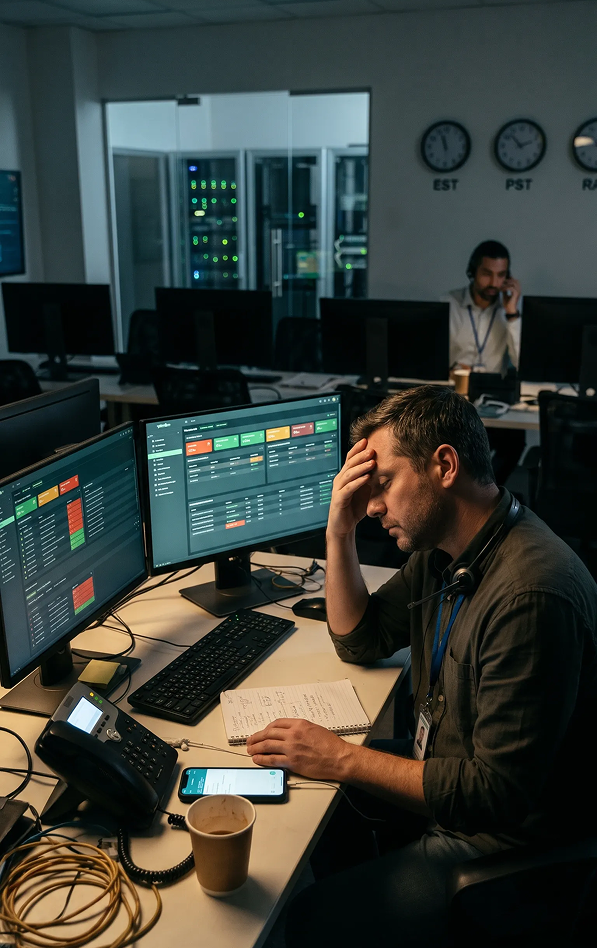
Evening and weekend requests waited for the next staffed shift.
Senior engineers were paged for routine access problems alongside genuine outages.
Handover quality depended on who was available overnight.
Eastern and Pacific users created support demand across extended hours.
Remote support boundaries and approval needs were not defined.
Users received different service depending on when they called.
Provided a rostered L1/L2 desk with a named shift lead, relief cover, peak-demand planning, and handover time to complement the MSP's existing schedule.
Verified requester identity and confirmed entitlement before acting on any access, endpoint, or connectivity request.
Resolved common endpoint, access, and connectivity issues using approved runbooks within agreed remote support limits.
Routed P1 incidents through a continuous escalation path to named internal contacts, separate from noncritical business-hours obligations.
Gave requests needing change approval, onsite work, or a specialist a documented next action and owner instead of an unsupported promise.
Flagged open P1/P2 incidents, promised updates, blocked requests, and client-impact changes, with the daytime owner accepting each handover in the PSA.
Stored timestamps in UTC, displayed each client's agreed local time, and used named time zones and holiday schedules so daylight-saving changes did not create gaps.
Reviewed unnecessary pages, failed handovers, and user feedback each week, without suppressing legitimate escalation.




| Operational Metric | Before | After |
|---|---|---|
| Staffed user-support coverage | 50 hours/week | 168 hours/week |
| After-hours P1 human-response p90 | 55 minutes | 15 minutes |
| Noncritical after-hours first-response median | 240 elapsed minutes | 30 elapsed minutes |
| After-hours first-contact resolution | 48% accounts | 70% |
| Internal overnight pages | 70% | 98% |
Maintained a staffed user-support queue across evenings and weekends, so eligible after-hours requests no longer had to wait for the next business day.
Moved routine access and endpoint issues to the after-hours desk, allowing senior engineers to focus on genuine outages.
Established accepted handovers in the PSA, giving the daytime team clear owners, next actions, and promised updates.
Used the MSP’s approved identity and language for every after-hours interaction across client time zones.
Established a repeatable coverage model to help manage expanding client hours without relying exclusively on additional internal hires.

Expanded combined internal and partner coverage from 50 to 168 hours per week.
Reduced the p90 human response for after-hours P1 incidents from 55 to 15 minutes.
Reduced the median first response for after-hours portal and email requests from 240 to 30 elapsed minutes.
Reduced overnight pages to internal engineers from 36 to 18 per month.
Increased the share of open overnight tickets accepted by the day team with an owner, next action, and promised update from 70% to 98%.
“Extending our service desk into evenings and weekends has helped us establish a more structured approach to after-hours support. Accepted morning handovers and clear escalation limits have made it easier for our daytime team to pick up overnight work without gaps.”
An after-hours service desk provides staffed L1/L2 end-user support during evenings, nights, and weekends. It helps MSPs respond to user requests outside normal business hours.
White-label after-hours support enables MSPs to extend support hours while retaining ownership of client relationships. The desk uses the MSP’s approved identity, language, and escalation procedures.
Yes. After-hours teams can work within an MSP’s existing PSA, telephony, RMM, and documentation platforms, provided routing, recording consent, access, and integration suitability are reviewed.
Depending on the agreed scope, the desk can verify identity, confirm entitlement, resolve common issues through runbooks, escalate P1 incidents, and prepare morning handovers.
Routine access and endpoint issues are handled by the after-hours desk rather than paged to senior engineers. Genuine outages still follow a continuous escalation path.
Response times depend on the MSP’s severity definitions and service commitments. A 15-minute p90 objective can help set expectations, provided the clock runs continuously from intake to ownership.
After-hours user support handles requests raised by end users. 24/7 NOC monitoring watches infrastructure for alerts and incidents, often before users notice an issue.
MSPs should track staffed coverage, P1 response, noncritical first response, first-contact resolution, overnight pages, and handover completeness. Small P1 cohorts need counts and longer review periods.
No. Remote support improves response outside business hours, but it cannot replace onsite access, vendor support, or approvals from unavailable client contacts.
An MSP should evaluate coverage schedules, staffing and relief plans, identity verification, escalation paths, handover standards, time-zone handling, reporting methods, and total operating costs.
After-hours support requires more than an answered phone. It requires verified requesters, defined resolution limits, continuous P1 escalation, and accountable morning handover.
Moksh Tech helps MSPs strengthen service delivery through white-label service desk support and Managed IT Support Services in the USA.
Explore how the right coverage model can help your team map evening and weekend demand, review after-hours contact mix, and define a practical support boundary.