

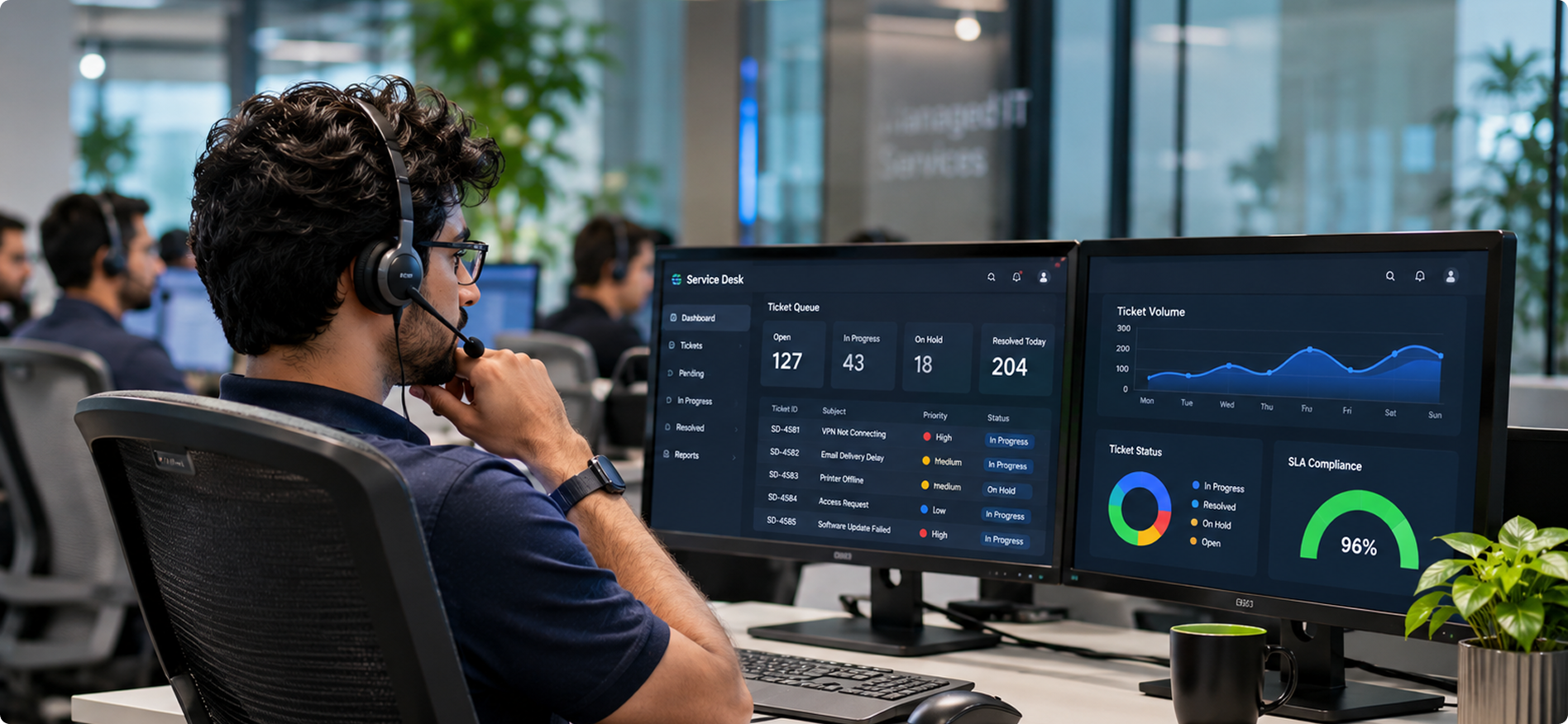
The client is a U.S.-based Managed Service Provider (MSP) supporting approximately 1,200 users across 40 small and midsize business clients.
Its internal technicians and escalation team handle approximately 1,500 eligible support tickets per month across access, endpoint, and Microsoft 365 requests. However, new client onboarding increased routine request volume, leaving senior technicians balancing simple tickets with urgent incidents.
As the MSP expanded its client base, older tickets remained without clear next actions, and users received inconsistent updates. The business needed additional first-line capacity while keeping technical judgment and client relationships under its control.

New clients increased access, endpoint, and Microsoft 365 requests.
Experienced engineers balanced urgent incidents with simple tickets.
Older tickets remained open without clear owners or next actions.
Users received irregular communication on request status.
Unconfirmed resolutions caused users to reopen the same issue.
Rework consumed capacity already sold under recurring contracts.
Added a dedicated L1 queue team led by an L2 engineer, sized after reviewing ticket arrival patterns and handling times.
Used the MSP's service calendar, phone greeting, email identity, and ticket templates, while L3 incidents remained with its specialists.
Separated the aged backlog from new intake, giving each legacy ticket a validated owner, client update, and documented next action.
Classified new requests by impact, urgency, and entitlement to route work to the appropriate support level.
Required identity verification before any account recovery or access change, keeping security controls ahead of resolution speed.
Resolved repeat issues using approved knowledge articles and recorded resolution steps in the existing PSA.
Maintained one intake across phone, portal, and email, with distinct waiting statuses, aging alerts, and direct P1 paging to the incident lead.
Held daily queue reviews to clear blocked work and weekly quality sampling to check technical accuracy, communication, and premature closure.



| Operational Metric | Before | After |
|---|---|---|
| Open tickets older than five business days | 180 | 60 |
| First human-response median | 95 business minutes | 30 business minutes |
| Resolution SLA compliance | 87% | 95% |
| First-contact resolution | 61% | 73% |
| CSAT mean | 4.1/5 | 4.5/5 |
| Seven-day reopening rate | 9% | 6% |
Gave every open ticket a validated owner and next action, reducing the aged backlog and improving visibility across the queue.
Moved routine requests into a structured L1 workflow, allowing senior engineers to focus on complex incidents and preventive work.
Introduced regular updates and confirmed resolutions, giving users a clearer view of their request status.
Paired faster response with reopening and CSAT measures so that speed did not come at the expense of resolution quality.
Established a repeatable L1/L2 model to support client growth without relying exclusively on additional internal hires.

Expanded staffed monitoring from 40 to 168 hours per week.
Increased the share of Priority 1 incidents receiving a human response within 15 minutes from 72% to 95%.
Reduced internal after-hours workload from 64 to 32 hours per month.
Reduced mean restoration time from 5.6 hours to under four hours.
Reduced mean restoration time from 5.6 hours to under four hours
“Adding dedicated L1 and L2 capacity has helped us establish a more structured approach to queue management. Clear ticket ownership, consistent client updates, and confirmed resolutions have made it easier for our senior engineers to focus on complex incidents and preventive work.”
Service desk support for MSPs provides L1 and L2 handling of end-user requests, ticket documentation, client updates, and escalation to designated technical teams. It helps MSPs add first-line capacity as they grow.
White-label service desk support enables MSPs to extend support capacity while retaining ownership of client relationships and service delivery. The team works under the MSP’s phone greeting, email identity, ticket templates, and service calendar.
Yes. A service desk team can work within an MSP’s existing PSA, RMM, Microsoft 365, and documentation platforms, provided the required access, permissions, and licensing are supported.
Depending on the agreed scope, a service desk team can classify tickets, resolve routine requests, verify identity before access changes, update clients, and escalate complex issues to the MSP’s engineers.
A dedicated L1 team handles routine access, endpoint, and Microsoft 365 requests within agreed workflows. This allows senior technicians to focus on complex incidents and preventive work.
Response times depend on the MSP’s service commitments and ticket priorities. A 30-business-minute median for first human response can help set expectations, provided automated replies are excluded and the p90 is reported separately.
First-contact resolution measures the share of eligible live contacts resolved without a transfer or a same-issue reopening within seven days. Resolution SLA compliance measures the share of tickets resolved within their agreed resolution deadline.
MSPs should track aged backlog, first-response time, resolution SLA compliance, first-contact resolution, CSAT, and reopening rates. Measurements should use the same service calendar, category mix, and definitions across periods.
No. A rise in simple requests, such as password resets, can lift first-contact resolution without improving complex support, so it should be reviewed alongside ticket mix, reopening rates, and CSAT.
An MSP should evaluate service scope, L1/L2/L3 responsibilities, white-label communication standards, identity verification controls, tool compatibility, reporting methods, and total operating costs.
Scaling a service desk requires more than additional technicians. It requires clear queue ownership, verified access controls, consistent client communication, and quality accountability.
Moksh Tech helps MSPs strengthen service delivery through white-label service desk support and Managed IT Support Services in the USA.
Learn how the right L1/L2 model can help your team reduce backlog, improve resolution quality, and support growing client demand.